

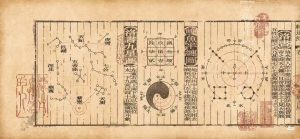
Despite geographical separation and cultural differences, humanity’s desire for “symbolic protection” is strikingly similar. The Eastern Daoist Fu and various Western talismans/amulets are like mirrors, reflecting how different civilizations, when facing the unknown, used their own cultural “grammar” to write similar “declarations of peace of mind.”
Core Difference: Systematic Belief vs. Animistic Remnant
Traditional Daoist Fu talismans are rooted in a grand, systematic theology and cosmology (e.g., the Daoist pantheon, Yin-Yang and Five Phases, Qi theory). Their words (edicts) and graphics (star charts, trigrams) aim to “command troops,” ordering or borrowing sacred forces within the cosmos. It is an active, systematic command system.
Many Western traditional talismans (e.g., horseshoes, rabbit’s feet, Evil Eye charms) often originate more from pre-Christian animistic beliefs, folklore, or sympathetic magic (law of similarity, law of contact). Their power is often believed to be intrinsic to the object itself (e.g., the iron of the horseshoe repelling evil) or from its symbolic primal metaphor, with weaker systematicity.
Form Contrast: Text-Dominant vs. Image-Dominant
Eastern talismans heavily rely on esoteric scripts and highly abstract graphic combinations. Their efficacy is closely tied to the practitioner’s “power” and the completeness of the ritual, representing a higher knowledge barrier.
Western talismans more commonly feature concrete natural objects (herbs, stones, animal parts) or symbolic jewelry (cross, Eye of Horus). Their use is more intuitive, often associated with simple acts like wearing or placing, staying closer to daily life.
Shared Essence: Psychological Schema and Meaning-Making
Stripped of cultural trappings, their core function is identical: to provide the individual with a controllable “fulcrum of meaning” in an uncertain world. Whether wearing a necklace with runes or posting a house-protecting Fu, both acts use a culturally recognized symbol to “materialize” and “personalize” abstract feelings of safety, courage, or luck, thereby stabilizing emotions and influencing behavior.
Conclusion
This cross-cultural dialogue tells us that the creation of “protective symbols” is a universal psychological need. Different civilizations provided different “toolkits,” but the object of repair was always the anxiety of the mind. Understanding these differences and commonalities not only deepens our knowledge of our own culture but also allows us to view the world’s rich spiritual heritage with more open and appreciative eyes. Today, whether it’s Eastern meditation beads or Western positivity crystals, we continue this ancient conversation.